
Enrolling now · The January Term starts on 5 January · Enrolment closes on 1 January (10 days left)

Reserve your space
Classical Drawing FoundationsLevel I · January Term Fee and dates

Paris Atelier of Realist ArtLive online course

Classical Drawing Foundations

Level I · January Term · six weeks, live

You don’t need ten thousand references, nor another hundred hours of video. You need a trained eye on your drawing.

A drawing moves forward when someone watches you draw and tells you what to change, and why. In this six-week live course, your grip, your strokes, your angles and your approach are corrected individually, in every class.

Winter 2026 is full

  • Monday cohortFrom Monday 16 NovemberFully booked · 9 of 9 places
  • Tuesday cohortFrom Tuesday 17 NovemberFully booked · 9 of 9 places
January Term · Tuesday cohort From Tuesday 5 January Places open

Enrolment closes when the group is full.

Sound familiar?

If you’ve been learning on your own

You’ve probably done what the internet told you, and your drawings still don’t look right. See if you recognise yourself.

  • My phone is full of references.

    A reference shows you what to draw. It can’t show you where your drawing went wrong.

  • I’ve watched hours of tutorials.

    A video explains the same steps to everyone and corrects no one. It never sees your paper.

  • I can tell it’s wrong. I can’t tell why.

    A trained eye sees the cause in seconds. By the end of the course, so will you.

  • Maybe I just don’t have the talent.

    Drawing is a skill with a method, and the ateliers have taught it for centuries.

Videos and practising alone are flexible and cheap, and both have their place. What neither can give you is someone looking at your drawing and telling you what to change, and why.

None of this is a lack of talent. It is a lack of feedback.

What we do about it

We built Level I to give you that feedback, every week.

  • Every class is live.You draw while a trained eye watches, and your drawing is corrected on the spot. Nothing is sent to you as a recording.
  • Your hand is on camera, as well as your paper.Grip, stroke, the quality of the line: we look at each in turn.
  • In a group of nine, every correction is a lesson.You learn almost as much from the corrections to other people’s drawings as from your own.
  • You learn to find the error yourself.By the last class you know which mistake you have made and which of five questions catches it. The five come next.

The SIGHT Method

We teach the SIGHT Method, so you can correct your own drawing

Most courses teach steps. Steps get a drawing to the end; they don’t tell you what went wrong when it doesn’t look right.

At the atelier you learn five questions to ask of every drawing, in the same order, every time. Each catches a different kind of error. Together they are the SIGHT Method.

The five lettersThe question

  1. S · ShapeHave I drawn a volume, or a flat outline?
  2. I · InclineHas an angle drifted?
  3. G · GapsDid I measure this distance, or guess it?
  4. H · HierarchyIs this tone in the right place on the value scale?
  5. T · TransitionsDo light and shadow turn the form?

In class it sounds like this. Look at the gap between the eyes. Is it one eye wide, or did you guess? The jaw is steeper than the model’s. Check the incline against the ear. One question, one correction, and you know which of the five it belongs to.

Five is a short list, deliberately. It has to fit in your head while the pencil is in your hand. You learn the five one at a time, each resting on the one before, and by the last class you are the one asking them.

A drawing that goes wrong stops being a verdict on you. It becomes the answer to one of five questions, and you know which one.

Curriculum

What you learn in six weeks

Five skills, taught in order, each resting on the one before. This is everything Level I covers.

  • Seeing volumeDrawing a form in three dimensions, not a flat outline: the centre line and the contours that wrap it.
  • The big shape firstBlocking in the large mass with straight lines before any detail.
  • MeasuringComparative measurement with the pencil: distances checked against one another, not guessed.
  • ProportionBuilding the proportions of a head or an object by measuring, and checking them as you go.
  • Angles and inclinesReading the tilt of a line against the model, and catching one that has drifted.
  • The logic of light and shadowWhere the light comes from, where the shadow edge runs, how shadow turns the form.
  • The value scaleFinding the lightest and darkest points and placing every tone between them, deliberately.
  • Tonal controlBuilding volume with tone, and choosing every tone on purpose.
  • Drawing what you seeObservation over memory: the eye half lost in shadow, not the almond shape you know.
  • Using a referenceHow to check your drawing against a reference instead of copying it line by line.
  • Self-correctionThe five SIGHT questions, asked in order, until they become your own.
  • One drawing, start to finishAll five skills together in a single drawing, from the first line to the last tone.

How a class runs

What actually happens in a class?

Two hours on Zoom, in three parts. You draw for most of it.

  1. What are we drawing today?

    The week’s problem is drawn live, in front of you, with the reasoning said out loud.

  2. Now you draw.

    At your own table, step by step, at the same time as everyone else.

  3. Where did it go wrong?

    Each drawing is looked at in turn and corrected on the spot, in front of the group.

When are the classes?
Every Tuesday, 3 – 5 pm Paris time, on Zoom.
What happens between classes?
One assignment, reviewed in the next class, and a few 15–20 minute practice sessions a week. You always know exactly what to draw.
What if I miss a class?
Classes aren’t recorded, because they are built around drawing live. Instead, you have two make-up classes a term. You still receive the week’s exercise, and we look at your drawing the following Tuesday.
What do I need?
Pencil, eraser, sketchbook. A tablet works if you draw digitally.

The promise

What six weeks will and won’t do

We won’t tell you that you’ll be a master in six weeks.

What we can tell you: after six weeks you will know how to check your own drawing. You will measure a proportion instead of eyeballing it. You will notice an angle that has drifted before anyone points it out. The questions you hear in class will have become the ones you ask yourself, at your own desk, with nobody watching.

Is it for you?

Who this course is for

We say this plainly because we want the right people in the group.

It suits you if

  • You’re a complete beginner.You’ve never drawn and don’t know where to start. This is a foundation built from zero.
  • You’re coming back after a break.You used to draw but haven’t picked up a pencil in years. This is a structured way back.
  • Your results are inconsistent.Some drawings work and some don’t, and you can’t say why. Once you know why a good drawing is good, you can repeat it.
  • You rely on a grid or tracing.You can draw with a grid, tracing paper or a projector, but struggle freehand. Measuring teaches you to build proportion with your own eye.
  • You’re stuck practising alone.The problem is usually not how much you practise, but what you practise and whether anyone checks it.

It may not suit you if

  • You want to learn anime, cartoon or stylised drawing.The atelier teaches classical realism, drawn from observation.
  • You want a ready formula in a few lessons.The method settles step by step, with regular work.
  • You only want to watch.In class, you draw.
  • You’re under 18.We teach adults only.
Not sure? Answer three questions. If Level I isn’t the right starting point, we’ll say so on screen, and point you to Level II or private lessons.Find my starting point

Find your starting point · 30 seconds

Which course fits you?

1Where are you now?
2What holds you back most?
3How do you want to work?

The teacher

Who teaches the course

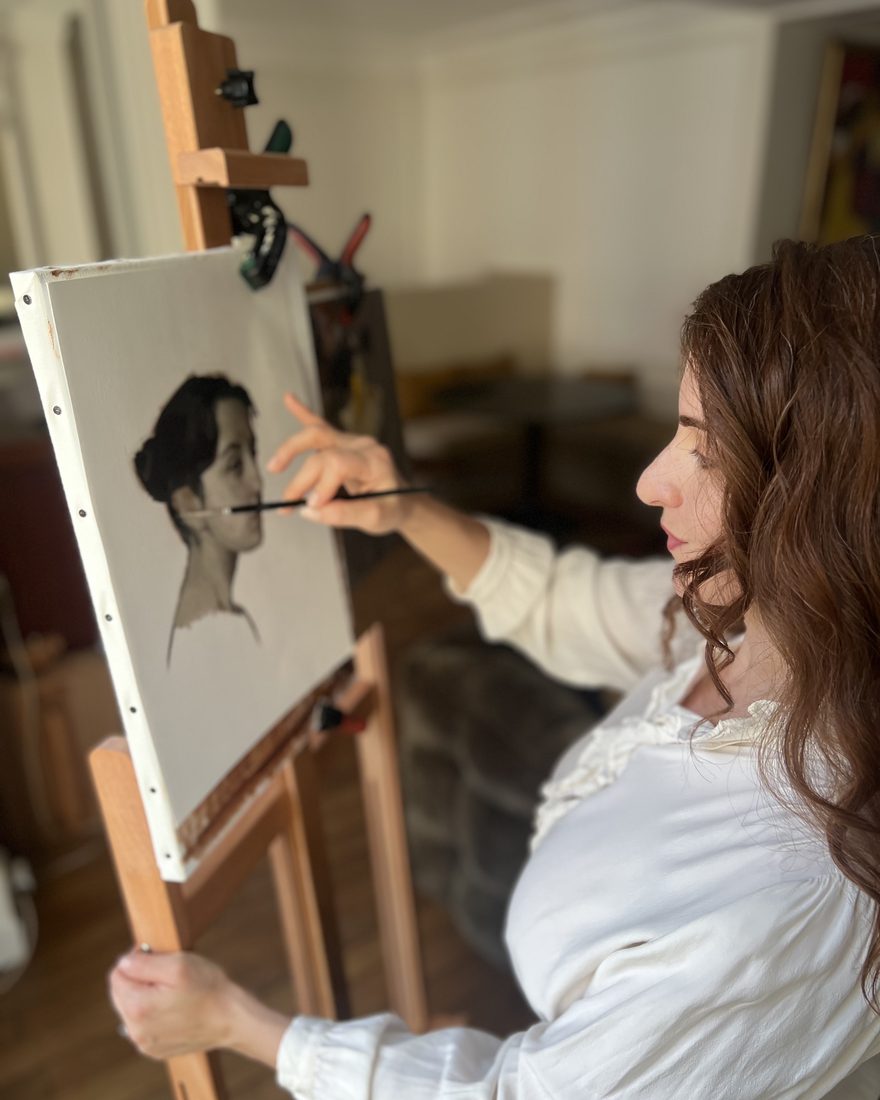
Handan Uslu-Desachy working on a portrait at the studio

Founder, programme director and teacher

Handan Uslu-Desachy

Handan Uslu-Desachy is a realist figure and portrait artist based in Paris. She came to classical realism in 2019 at The Drawing School in Dublin, then trained at AARP, Porto, in 2024–2025 under Daniel Gamelas and André Soares. She has also studied with Ivan Loginov and Gustavo Ramos.

Before drawing, she trained as an engineer, with a double degree in Mechanical Engineering and Economics from Koç University and a master’s from Georgetown University. That habit of mind runs through the atelier’s teaching: a complex problem broken into an order of steps, each checked before the next.

“I built Classical Drawing Foundations as the programme I wish I’d been given when I started. In order, not at random. Simple, not complicated. And we don’t leave you on your own.”Handan Uslu-Desachy

Enrolment

Fee and dates

Classical Drawing Foundations · Level IEnrolling now

€497

Twelve hours of live teaching, with individual correction in every class.

Included

  • Six live group classes of two hours, drawing throughout
  • Individual instruction: your grip, strokes, angles and approach corrected in every class
  • Two make-up classes if you miss a class
  • A weekly assignment, reviewed in class
  • A checking question for each of the five skills
  • The Drawing Reference Archive: 200 master drawings
  • The 100-Day Practice File: 40 pages of practice documents, yours to keep

Not included: your materials (pencil, eraser, sketchbook).

Full refund up to five days before the course begins. Cancel by Thursday 31 December and we refund you in full.

Reserve my place

We confirm your place and send the payment details by email.

Winter 2026 is full

  • Monday cohortFrom Monday 16 NovemberFully booked · 9 of 9 places
  • Tuesday cohortFrom Tuesday 17 NovemberFully booked · 9 of 9 places

After you pay

  1. Right awayPayment confirmation

    A payment confirmation by email.

  2. Within 24 hoursWelcome email

    Your enrolment details, the materials list and how to reach us.

  3. Before the first classThe Zoom link

    By email. No paid Zoom account needed.

  4. Tuesday 5 January, 3 pm (Paris)The first class

    Two hours live on Zoom, drawing from the first minute.

  5. Every weekClass and critique

    Class notes, your assignment and individual critique of your drawing.

Frequently asked questions

Before you enrol

If your question isn’t here, write to info@atelierrealiste.fr. We reply within 24 hours.

I’ve never drawn. Can I really do this?

Yes. The programme starts from zero. In the first class, the first thing we do is draw a line.

Isn’t it too late to start at my age?

No. The programme is designed for adults starting from scratch. What decides your progress is the right order and regular practice, not your age.

Can I get a refund?

Yes, up to five days before the course begins. Cancel by Thursday 31 December and you get a full refund. Full details are in the terms of sale.

What materials do I need?

A pencil (HB and 2B are enough), an eraser and a sketchbook. If you draw digitally, a tablet and a drawing app work too. The full list arrives by email after you enrol.

Paper or digital?

Either. What you learn is seeing and drawing, and that works the same on paper and on screen.

I don’t have much time. Can I keep up?

One two-hour live class a week. In between, a few 15–20 minute practice sessions a week are enough.

When and where are the classes?

Every Tuesday, 3 – 5 pm Paris time, on Zoom. You draw throughout the class and get feedback as your drawing moves forward.

What if I miss a week?

Classes aren’t recorded: they are built around drawing together, live. Instead, you have two make-up classes a term. You still receive that week’s exercise and send us your drawing, and we look at it together in the next class.

What is the Reference Archive?

A collection of 200 master drawings, chosen by the atelier for study and copying. Access is included in the Level I fee, from your first class.

Is a difference in level a problem?

No. Everyone moves through the same sequence, and corrections are made on each student’s own drawing, so differences in level keep no one waiting.

Can I get an invoice?

Yes. An invoice is issued for every enrolment.

What language are the classes in?

English.

What happens after the programme?

The 100-Day Practice File stays with you, so you can make what you learned stick with short daily exercises. If you want to go further, the next step is Portrait · Level II, also online.

Enrolling now

The January Term begins on Tuesday 5 January.

Six live classes in a small group, with your drawing corrected in every one. Enrolment closes when the group is full.

Reserve my place

Prefer to ask first? Write to info@atelierrealiste.fr. We reply within 24 hours.